

I decided to start this series by sharing some of the struggles that creatives face in the pursuit of their passion projects, and one of the first hardships that came to mind is how pressure affects creativity. So without further ado, let me share with you my unsolicited views on how pressure is the enemy of creativity.
How do we create pressure?
We tell ourselves, “I should create amazing art!” I should make art that belongs in museums. I have to create bigger paintings, better clothing pieces, more trendy music, entertaining content, etc.
“I should,” “I have to,” and “I need to.” All these expressions imply obligation.
Obligation creates pressure.
And pressure makes you procrastinate.
Instead of doing the things you said you need to do, your brain looks for any excuse to avoid it all.
Creative people tend to rebel against obligation.
And so instead of sitting down to create freely, you force yourself to create like a picky child is forced to eat vegetables.
The pressure of choosing a career
To make matters worse, the external world pushes social norms upon us at a very young age. Many artists start making art as children, and once they grow up, they find themselves facing two realities: choosing an art career and struggling financially, or having to do something else that makes good money but isn’t art-related.
And this dilemma happens because many creative people, myself included, even though they have so many interests, try their best to focus on a niche and give it their all. However, as hard and confusing as it is to be everywhere and do everything, that versatility keeps our brains going.
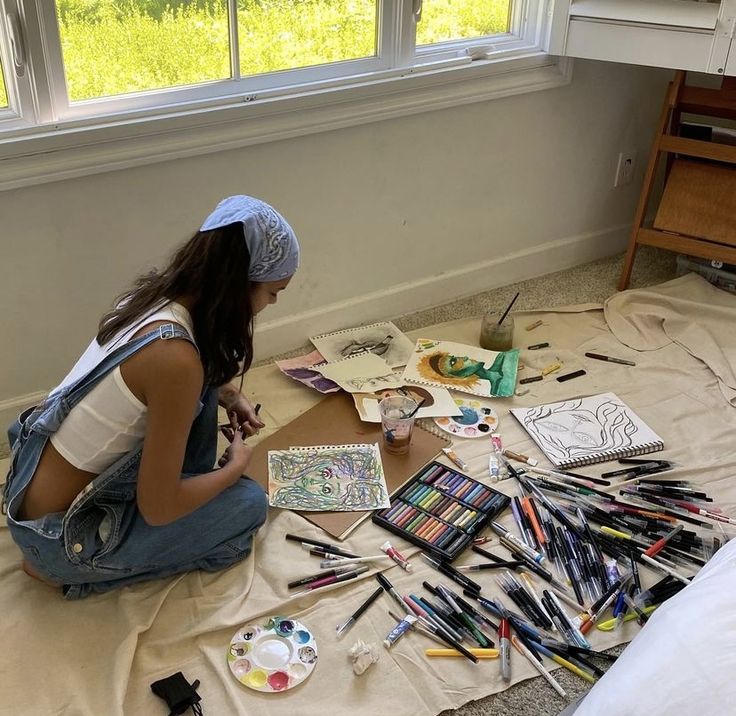
When we are young and don’t know much about life, we seek guidance from the older people around us and assume they have it all figured out. But as a child, nobody in my circle did art for a living. Everyone had a serious job, and only a few even had a hobby or practiced their hobbies, to be more exact.
Realising that creativity is the road less travelled
The more I analyzed the jobs people had, the more I began to see being an artist as an unattainable dream. Not to say that I think differently today. Being a full-time artist still feels like a luxury and more of a dream than something you can easily work towards.
And maybe that’s where the pressure quietly begins.
Not when you start creating, but when you start thinking about what creating should lead to.
Because the moment art becomes something that needs to justify itself, financially, socially, or intellectually, it stops being a playground and starts feeling like a test.
And most of us are not afraid of creating.
We are afraid of failing the test.
When creativity becomes performance
At some point, creating stopped being about expression and started being about outcome.
Will people like this?
Will this perform well?
Is this good enough to be seen?
And suddenly, you’re no longer creating with yourself.
You’re creating in front of an invisible audience.
An audience that is always watching, always judging, and somehow never satisfied.
That’s pressure.
And the worst part is you created it.
The illusion of “good art.”
We convince ourselves that there is such a thing as objectively good art.
The kind that gets validation.
That gets shared.
The kind that gets you closer to that imaginary life where everything makes sense.
But the truth is, most of the art you love today probably wouldn’t survive your current standards.
Because it wasn’t made under pressure.
It was made out of curiosity, boredom, obsession, or even confusion.
It was made freely.
So what do we do with all this pressure?
We don’t eliminate it.
That would be unrealistic.
Pressure is everywhere. In expectations, in comparison, and in the desire to build something meaningful.
But maybe the goal is not to remove pressure.
Maybe the goal is to stop obeying it.
To notice when creativity turns into obligation… and gently step away from that mindset.
To create things that don’t need to be shared.
And make things that don’t have a purpose.
And allow yourself to be bad, inconsistent, and unfinished.
Because ironically, that’s where your best work is hiding.
A small shift that changes everything
Instead of saying, “I should create something amazing.”
What if you said, “I’m curious to see what happens if I sit down and create today”?
No pressure.
Expectations.
Or audiences.
Just you, your ideas, and whatever comes out of it.
Conclusion
I still feel the pressure.
Every time I sit down to create something that matters to me, there’s a voice in the back of my mind telling me to make it worth it.
Make it good.
Impressive.
And make it meaningful.
And every time I listen to that voice, I create less.
But when I ignore it, even just a little, I find my way back to why I started in the first place.
Not for results.
Not for validation.
But because creating makes me feel like myself.
And maybe that’s enough.
